What if the reason your revenue isn’t growing has nothing to do with traffic?
Your sessions are up. The marketing report is full of green arrows. And yet — the revenue number hasn’t moved.
If that sounds familiar, you’ve been solving the wrong problem. When revenue goes flat, the instinct is to spend more on traffic. But if your website converts at 1%, doubling traffic doesn’t double revenue. It doubles waste. Every extra visitor enters a system with a hole in it — and the hole doesn’t care how many people you pour in.
The fix isn’t upstream of the click. It’s downstream. And it’s almost always cheaper than another campaign.
Key Takeaways
- A 1% conversion rate can be a system problem, not a traffic problem.
- Going from 1% to 2% conversion doubles revenue with zero extra ad spend.
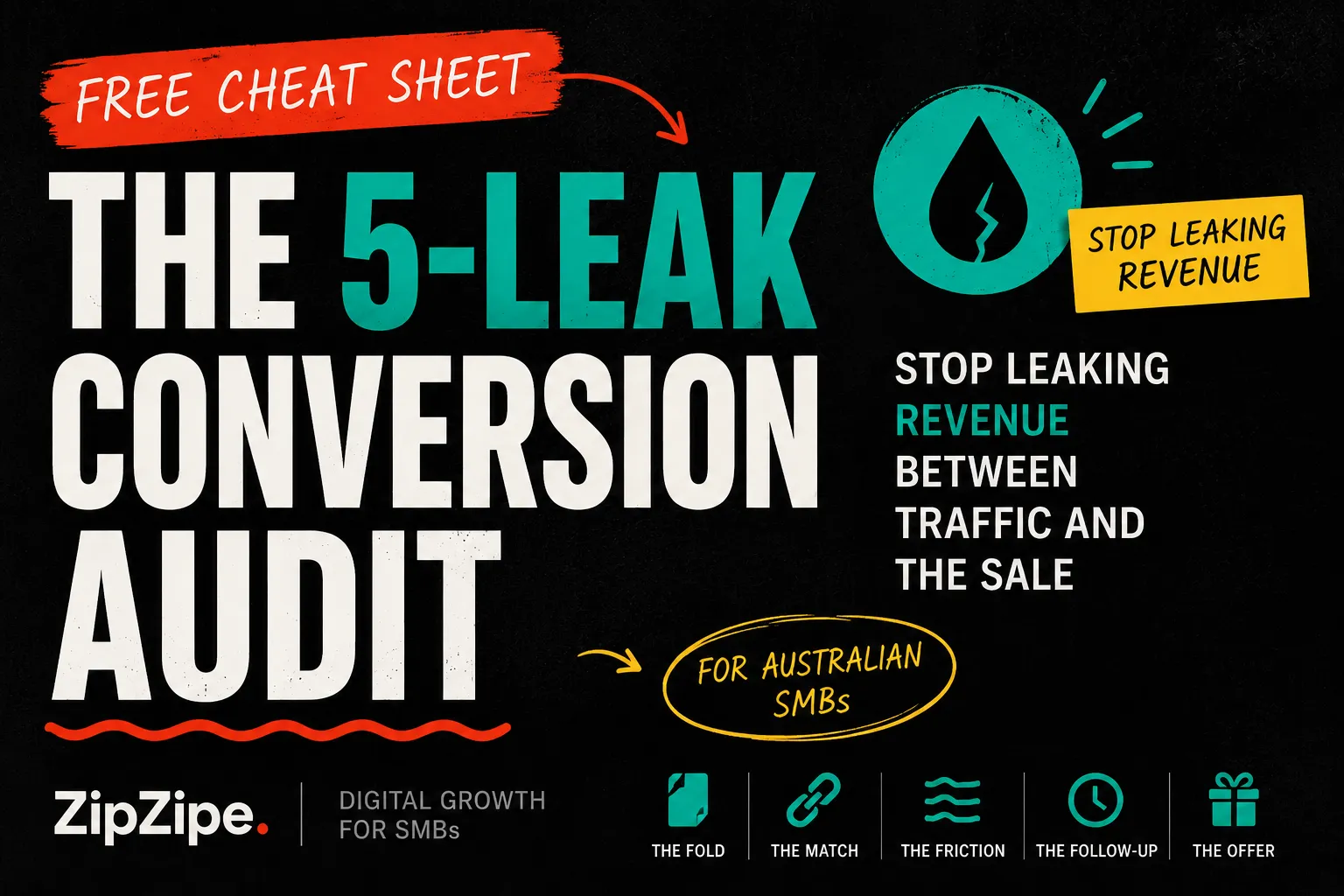
- Five leaks cause the most low conversion: fold, match, friction, follow-up, and offer.
- Fix conversion first. Scaling traffic into a broken funnel multiplies the leak.
- The correct order is always: conversion → traffic → scale.
Why doesn’t more traffic increase revenue?
Because the bottleneck is downstream of the click — not upstream of it.
Ad platforms optimise for clicks, not customers. SEO ranks pages for keywords, not buyer intent. So the layer getting the most investment (traffic) is the layer furthest from the sale.
Fixing conversion changes the economics of every traffic source at once. Fixing traffic changes only one number.
What is a good website conversion rate?
For Australian service businesses running paid traffic, 2–5% is healthy, with 3% a realistic benchmark. Top-performing pages reach 8–10%. At or below 1%, you have a system problem.
The leverage gap matters: going from 1% to 2% with the same traffic doubles revenue. Achieving the same result through traffic alone would require doubling your ad budget — at costs that don’t stay flat as you scale.
The five leaks behind most low conversion rates
In the audits ZipZipe runs for Australian businesses, three of these five are typically broken at the same time. The symptom — flat revenue despite traffic growth — looks identical regardless of which combination is causing it.
Leak 1: The fold Your mobile hero is a filter. Visitors decide to stay or leave in under three seconds. According to Google’s Think with Google research, 53% of mobile users abandon a page that takes longer than three seconds to load — before reading a single word. If your headline talks about your company instead of your visitor’s problem, you’re filtering out buyers before they reach the offer.
Leak 2: The match If your ad says “Free conversion audit” and your page opens with “We’re a full-service digital agency” — that’s a broken match. Visitors clicked for one specific reason. If they don’t see it confirmed immediately, trust evaporates. Message match is one of the cheapest conversion lifts available: no new traffic, no redesign, just rewriting the page to mirror what brought the visitor there.
Leak 3: The friction Form fields, page speed, early popups, cluttered navigation. Cutting a form from eleven fields to four can lift conversion by 30–50% on its own. Friction is invisible to site owners who’ve seen the page hundreds of times. To a first-time visitor, it’s loud.
Leak 4: The follow-up The Harvard Business Review / MIT Lead Response Management Study found that responding to an inbound lead within five minutes is 100 times more likely to result in contact and 21 times more likely to qualify the lead compared to waiting 30 minutes. Most Australian businesses respond in hours. By then, the lead has already called someone else.
Leak 5: The offer “Contact us” is not an offer. It’s a request for a favour with no context, no commitment signal, and no sense of what happens next. “Free 30-minute conversion audit, written report within 48 hours” is an offer — it removes the decision burden from the visitor. If you can’t describe your first step in one sentence, neither can your visitor.
Not sure which leak is costing you the most? ZipZipe maps exactly where your visitors are dropping off — no sales pitch, just a written audit. Book a free conversion audit →
Should you fix conversion or scale traffic first?
Fix conversion first — always.
Scaling traffic into a broken conversion system doesn’t accelerate growth. It accelerates loss. Every extra dollar of ad spend returns the same poor conversion rate at higher cost.
The right question when revenue is flat is not “how do we get more traffic?” It’s “what is our traffic doing when it gets here?”
Seven-day audit: fix the system before buying more traffic
Run this before increasing any spend.
Day 1 — Baseline. Record sessions, leads, qualified leads, customers, conversion rate, and revenue per visitor for the last 30 days. If you can’t calculate revenue per visitor, your first leak is measurement.
Day 2 — Measurement stack. Set up GA4 key events for real buyer actions only: form submissions, booked calls, qualified leads, purchases. Not page views. Not button hovers.
Day 3 — Mobile fold. Open your site on a phone. Can a visitor tell what you do, why it matters, and what to do next — without scrolling? If not, fix the hero before touching any campaign.
Day 4 — Message match. Compare your highest-traffic ad or search snippet to your landing page headline. The promise must continue unbroken from source to page.
Day 5 — Friction. Run PageSpeed Insights. Shorten forms to five fields maximum. Remove popups that fire before the visitor has read the page.
Day 6 — Follow-up. Set a five-minute response rule for all inbound leads. Route form fills directly into your CRM. For after-hours leads, an automated confirmation email that sets a callback expectation preserves leads that would otherwise cool overnight.
Day 7 — Offer. Replace every “Contact us” with a concrete next step. The visitor should know what they get, how long it takes, and what happens after they submit.
Recommended tools: Google Tag Manager, GA4, Google Search Console, PageSpeed Insights, Microsoft Clarity or Hotjar, and a CRM (HubSpot, Pipedrive, or Zoho). Add CallRail or WhatConverts if calls matter to your business.
Frequently Asked Questions
What is a good website conversion rate for Australian businesses?
For most Australian service businesses, 2–5% is a healthy range, with 3% a realistic target for those running paid traffic. Top-performing pages reach 8–10%. A conversion rate at or below 1% indicates a system problem — more traffic will not fix it.
Why won’t more traffic fix my low conversion rate?
Because the bottleneck is the conversion system, not the traffic source. If a site converts at 1%, doubling visitors doubles the waste — it doesn’t double revenue. The problem is downstream of the click, not upstream.
What are the most common reasons websites have a low conversion rate?
The five most common causes are: a weak fold (the above-scroll message doesn’t speak to the visitor’s problem), a broken match between the ad and the landing page, friction in forms or page speed, slow lead follow-up, and a vague or unclear offer. Most low-converting sites ZipZipe audits have three of these five broken at the same time.
How fast should you respond to a website lead?
Within five minutes. The Harvard Business Review / MIT Lead Response Management Study found that responding within five minutes makes a business 100 times more likely to make contact and 21 times more likely to qualify the lead compared to waiting just 30 minutes. Most Australian businesses respond in hours — by which point the lead has usually moved on.
Should you fix conversion before scaling ads?
Yes. The correct order is conversion → traffic → scale. Scaling ads before fixing conversion multiplies the existing leak — every extra dollar returns the same poor conversion rate at greater cost. Fix conversion first, then scale into a system that works.
How long does a website conversion audit take?
The self-audit above takes seven focused days. A structured audit with a specialist typically takes three to five business days and covers all five leaks in detail. ZipZipe runs these for Australian businesses and delivers a written leak map with a prioritised fix order — so you know exactly what to fix and in what sequence.
What does a working conversion system look like?
A functioning conversion system has a clean, unbroken chain from source to sale: traffic source → landing page → key event → CRM lead → qualified lead → customer → revenue. Once that chain exists, scaling traffic compounds. Without it, every extra dollar of traffic spend accelerates the leak.
What tools do I need to audit my website conversion?
Start with: Google Tag Manager, GA4, Google Search Console, and PageSpeed Insights — all free. Add Microsoft Clarity or Hotjar for on-page behaviour recordings. For phone-call attribution, CallRail or WhatConverts. For CRM, HubSpot (free tier), Pipedrive, or Zoho. You don’t need enterprise tools to run a first-version conversion audit.